

The Truth About Joan of Arc
Updated: Sep 30


Above: Joan of Arc tears, candy Sculpture of Joan inside church.


Above: stone sculpture oj Joan
Below: The modern church dedicated to Joan in Rouan France, which was made to look like a dragon from the outside.

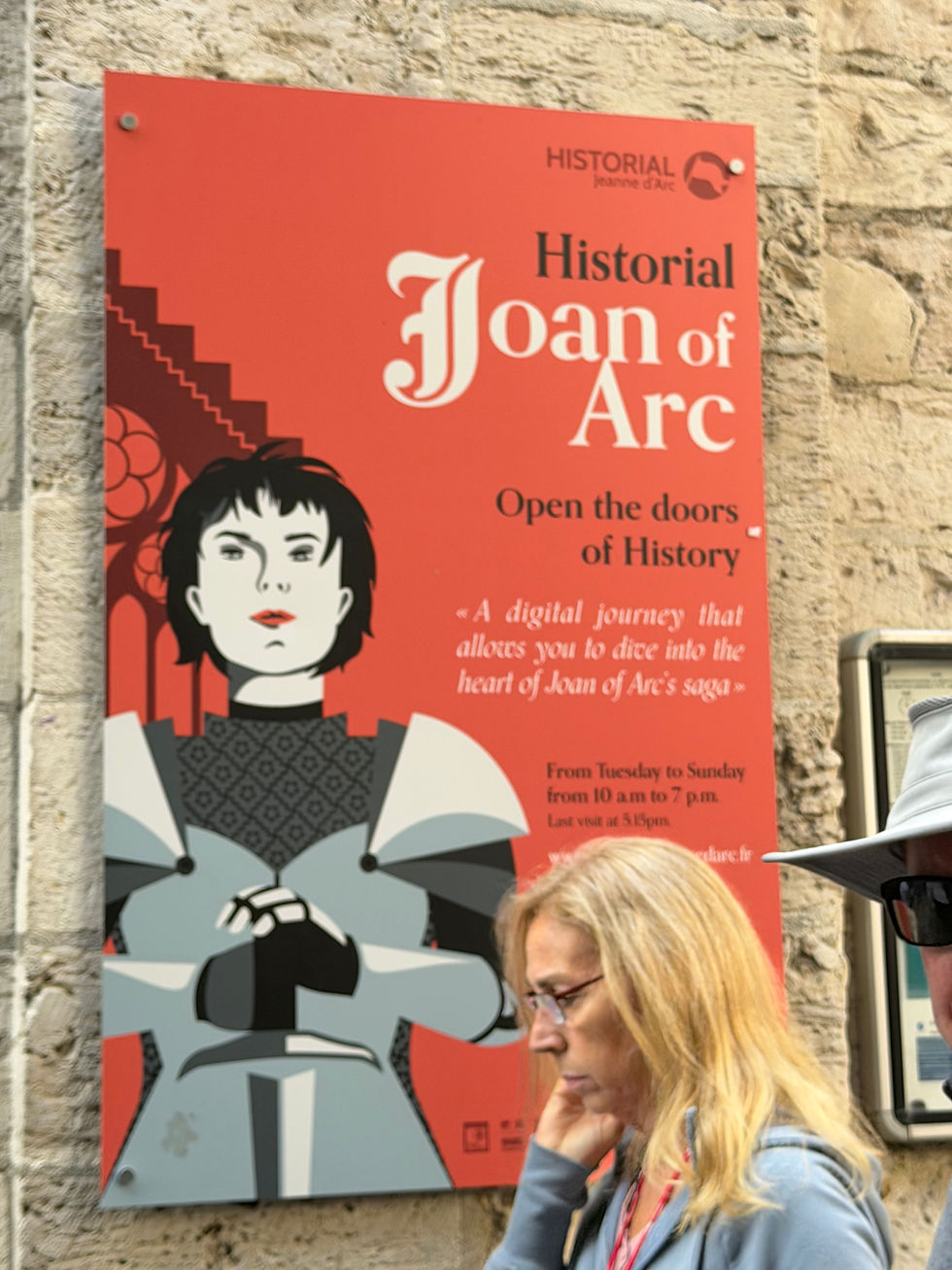
On my recent trip to France, my interest in Joan of Arc was once again piqued. I’d read a book about her years ago and was impressed with her passion and courage. She really was a very remarkable young woman. Tragically, she’d been burned at the stake for following the dictates of her calling and was declared a heretic. Today, most people consider her a heroine while others declare her delusional because she heard from God. While not usually considered a religious people, the French love their chaste maiden and even created a chocolate to commemorate her life: the tears of Joan of Arc. It’s an almond dusted with pure chocolate powder and just the right amount of sugar. Only the French would come up with a delicious gastronomical treat for the saint who gave her life for France. So, what’s her history?
Jeanne d’Arc was born to a peasant family in northeastern France during the medieval times of knights and jousting, impenetrable thick walls, and stone castles perched atop hills. It was a time of fair maidens, motes and royals imprisoned in tall towers. It’s a world that sparks our imagination and makes for Renaissance faires, filled with dragons and knights, both fact and fiction. According to a deep dive documentary I watched, there are more than 20,000 books written about Joan of Arc, more that nay other person and a number of documents from the 15th century. Some are definitely born of legend, but the acts are there also. Born in the late 1400’s according to most historians, Joan never learned to read or write, though she had more impact on the history of France than any king or queen. Her mother was a godly woman who taught her to love God and the Catholic Church. Joan or Jeanne in French, grew up with these ideals and was indeed a very religious young girl. She believed she heard God call her to make an impact and change the course of France who was losing their long-protracted war with England.
During her teenage years, England and France had been engaged in a bitter war which we later termed the 100 year War. At the time Joan lived, England had gained the kingdom over France. Henry the fifth was crowned king of both England and France since the French king had been declared illegitimate. Because England had the upper hand, many villagers in Joan’s town of Domremy were forced out of their homes. Her town was burned and pillaged twice. This injustice made a lasting impression on her, as she saw the evil of her enemies’ doings. As a thirteen-year-old girl, Joan began to experience divine visions from St. Michael, St. Catherine and St. Margaret who instructed her to help the Dauphin of France, the rightful King Charles VII.
These visions were the impetus that inspired her to take the course of action she did. She pursued and persuaded the Duke of Lorraine to gift her a sleek agile horse which she rode through dangerous enemy territory. Accompanied by six men over difficult lands, they arrived safely after seven days, which was attributed to her skill in riding and God. She then persuaded Charles of Valois to appoint troops for her to lead to the besieged city of Orleans. As she encouraged the disheartened men that God was on her side and theirs, most went willingly. Without any military training, (which some debate) she took charge, was given armor and a lance and lead the men to Orleans. She brandished it with ease and sent letters to the English to surrender, for God was on France’s side. Imagine that! A young teenage girl in charge of an army of men who listened to and followed her. That was a miracle in itself. But next comes the true miracle, they were victorious! How could a 14 year-old peasant girl achieve such military victory? Only the hand of God could have strengthened her to have such courage and assurance, which led her to be incredibly valiant. The visions were being fulfilled, as well as the prophecies that had circulated earlier that a young maiden would rescue France. The next step was to convince the Dauphin or prince Charles that he should go to Reims to be crowned King Charles VII. She escorted him there and he indeed was anointed with the holy oil that crowned the first monarch of France, Clovis 1. France was once again a viable nation with land and a king.
She continued to fight for her king, but was wounded by an arrow and captured by the Burgundy forces. Charles did not come to her aid because he wanted to sign a peace treaty with the Burgundians, which she denounced. Joan was later humiliated and sold to the English, who brought her to the town of Rouen in Normandy, Northern France. Here she was imprisoned and we were led to see with our own eyes the tower where she had been shackled. Next, the ecclesiastical trial ensued. The English were clever and appointed French judges who were loyal to the English. The guide then led us to the area where Joan had been burned at the stake, but the specific spot was not marked, just the area. The events that led up to this tragedy are most disturbing. Joan was tried by the church as a heretic, not a witch because she indeed was a virgin. They accused her of bypassing their authority in that she said she heard from God and saw visions. Not only that, they tricked her into signing a confession that she would abide by all the rules of the church. One of them was that she would not wear men’s clothing, which the church said was an abomination. According to their laws and how they interpreted the Bible, it was unlawful for a woman to wear men’s clothes, and worthy of punishment. However, they stripped her of her woman’s clothing and only offered men’s clothing, which she wore. On this technicality, she was declared a heretic!
It was all a political move because at that time the ecclesiastics supported England. It’s maddening to think that she was burned at the stake for this, but here’s where many legends are born. Some historians say that it wasn’t Joan who was burned but another woman. They covered her head so people wouldn’t know wo she was. Twenty years later she appears to her two brothers who recognize her. She calls herself Jeanne la Pucelle, the maiden. The name by which she called her. She then goes to Orleans and is hailed a hero and given 240 pounds, a hefty sum. Whatever the truth is about that we may never know, but this we do know. Jeanne la Pucelle made a lasting impact on all of European history. Later, the Church reversed their position and made her a martyr and Saint because Joan had saved France. All over Paris and France there are statues of her. Moreover in Rouen, the French commemorated a modern Church to her that symbolizes a dragon, honoring her memory and her fight against evil. Inside beautiful stained-glass windows from many other churches that no longer exist were installed in the church. There’s even a lesson in this---Joan of Arc’s enduring legacy. We also in America owe a debt to Joan of Arc since we received aid from France for our revolution that granted us freedom from Britain. Ultimately, His way leads to freedom, if not in this life, the next.
What impressed me most about Joan is her spirit. God give Joan the Maid a mission and she was true to what she was instructed to do. She had a close enough relationship to hear from God and believe deeply in Him. Though her life was in peril, she continued to press forward, assured that she had heard from God. She fulfilled her destiny as a woman of God, though her sex was later used against her in the trial. Not all of us can be a Joan of Arc, nor are we called to be her, but we are invited into relationship with the living God. We can hear from Him, for the Bible tells us that “the sheep know his voice.” We don’t want to be deceived and go off and do what we think God wants, but if we know the Word of God and know the savior, we can do what He asks of us. Joan gave her whole life for God and country. The French hold her in very high esteem. She is loved by both liberal and conservative, idealist and realist, traditional, and revolutionary. Why? Because she followed the dictates of God’s calling. In one word, she was obedient. Not because she had to, but the burning passion for God’s cause gave her the determination to do what she did. We too, as Christians, are called. We may be called to touch one life or 1 million. It doesn’t really matter. If we truly know and love God, He will help us do the impossible. “With man it is not possible, but with God, all things are possible” (Matthew 19:26). So think about it. What is God is calling you to do? Pray about it and listen for His still small voice. Thank you, Jeanne la Pucelle that you listened and obeyed!





Anita writes beautifully of the life of Jeanne d’Arc, incorporating historical insights as well as what we can glean from her life today. She was a young peasant girl that followed what she believed God was calling her to do. Dreams and visions led her, and French troops followed her as she rallied her country towards independence from their opponents. Reading this will inspire you to ask, as Anita concludes, ‘What is God asking you to do?’